 NBCNGMI™
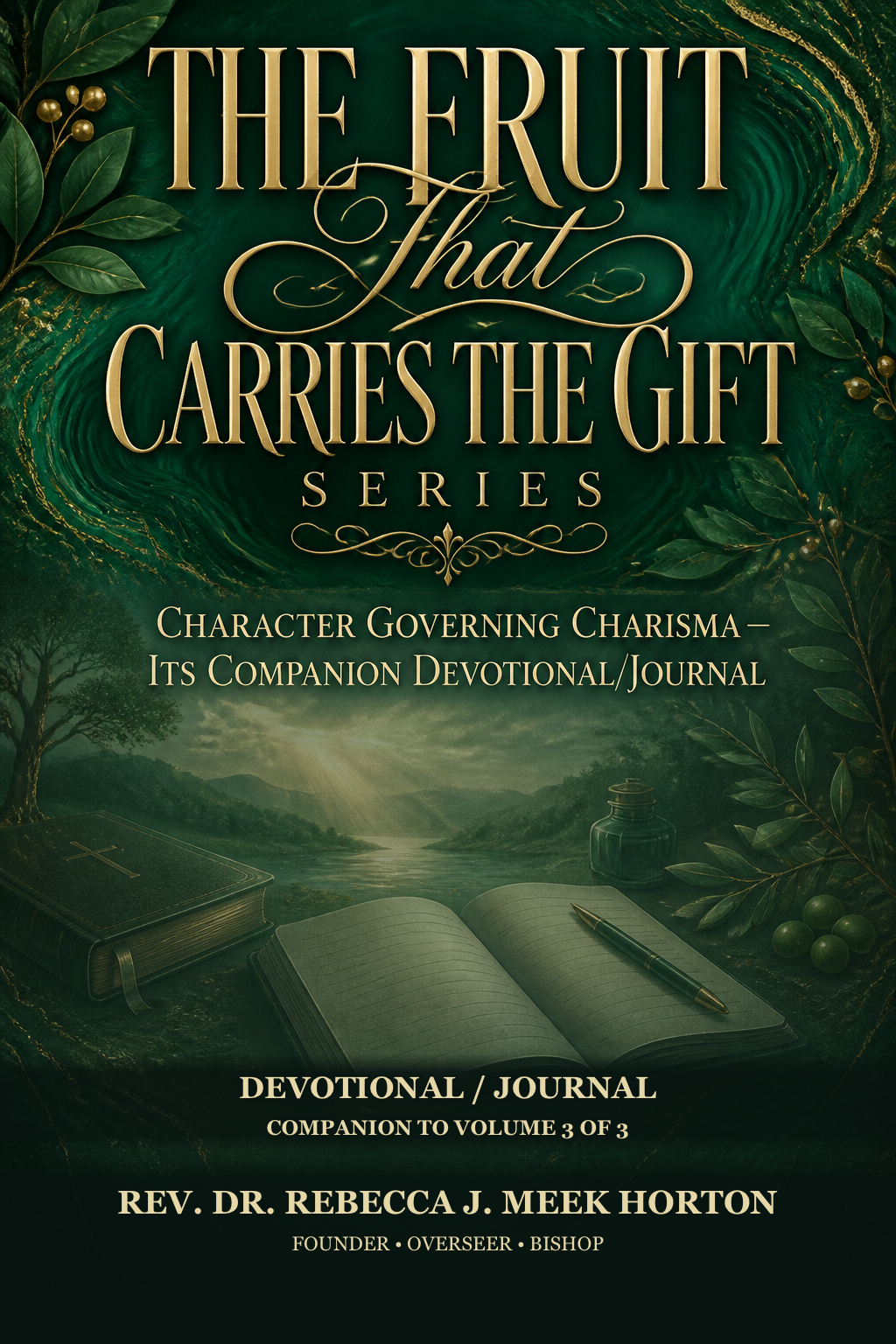
The Fruit That Carries the Gift · Volume 3
Character Governing Charisma — Its Companion Devotional/Journal
A companion devotional and journal for "Character Governing Charisma". Each chapter becomes five entries — a KJV Scripture reading, a devotional, a prayer, a journal prompt, and space to write — closing with An Apostolic Prophetic Architect Message and lined journal pages.
Chapter 1 preview
NBCNGMI MASTER KNOWLEDGE LIBRARY Featuring the works of The Sage, Apostle Prophet. Rev. Dr. Rebecca J. Meek Horton, Apostolic Prophetic Architect, NewBeing Creation Network Global Ministries, Inc. Integrated Framework Modalities™
Chapter 1 — When the Gift Outruns the Life
Entry 1
Scripture Reading
Galatians 5:22-23 (KJV) 22 But the fruit of the Spirit is love, joy, peace, longsuffering, gentleness, goodness, faith, 23 Meekness, temperance: against such there is no law.
Devotional
The Fruit of the Spirit is not decoration. It is not the soft part added after the real ministry happens. It is the life of the Spirit being formed in us so that whatever God entrusts to us can be carried safely.
Many people desire to serve well. We want our prayers to matter. We want our words to strengthen. We want our presence to help, not harm. That desire is holy when it is surrendered. But desire alone is not enough. A gift may make room for us, but Fruit teaches us how to stand in that room without using people, rushing moments, or needing attention to feel valuable.
Galatians does not say fruits, as if we may choose one and neglect the others. It says fruit. The Spirit forms one whole life with many visible expressions. Love governs motive. Joy keeps service from becoming bitterness. Peace refuses to make chaos holy. Longsuffering stays steady when people grow slowly. Gentleness remembers that bruised souls need careful hands. Goodness keeps integrity in the hidden place. Faith remains loyal when the outcome is unclear. Meekness carries strength without domination. Temperance restrains appetite, urgency, and emotion.
This is the inner government of a servant.
Without this government, charisma can move too quickly. A strong voice can become sharp. A powerful prayer can become performance. A word of correction can become control. A room can be gathered, stirred, and impressed, while the people inside it are not truly strengthened. That is why the Spirit does not only give gifts. He forms character.
There is mercy in being slowed down. There is mercy in the hidden work. There is mercy when the Lord reveals impatience before a platform increases, pride before influence expands, or fear before leadership grows heavier. What He exposes, He intends to heal and govern.
Today, do not ask only, “What can I do for God?” Ask, “What is God forming in me so I can serve others safely?” That question does not shame the servant. It protects the servant and the people being served.
The Fruit is the life that carries ministry. Let the Spirit form the life beneath the gift.
Prayer
Father, I come to You with an honest heart. I do not want my gift to outrun my formation. I do not want to gather people with charisma and then handle them without love, peace, gentleness, or self-control. Search the life beneath what others can see. Form in me the Fruit of Your Spirit. Teach me to slow down where I need to slow down, listen where I need to listen, and obey where I have been excusing immaturity. I receive Your correction as mercy, not rejection. Make my service safe, faithful, and pleasing to You. Amen.
Journal Prompt
Where do I most need the Fruit of the Spirit to govern the way I serve, speak, lead, pray, or respond?
Space to Write [Answer Lines]
Entry 2
Scripture Reading
1 Corinthians 13:1-3 (KJV) 1 Though I speak with the tongues of men and of angels, and have not charity, I am become as sounding brass, or a tinkling cymbal. 2 And though I have the gift of prophecy, and understand all mysteries, and all knowledge; and though I have all faith, so that I could remove mountains, and have not charity, I am nothing. 3 And though I bestow all my goods to feed the poor, and though I give my body to be burned, and have not charity, it profiteth me nothing.
Devotional
Paul’s words are not gentle to the ego, but they are healing to the soul. He names some of the most impressive expressions of spiritual life: tongues, prophecy, knowledge, faith, generosity, sacrifice. Then he says that without charity, without love, they become noise, emptiness, and loss.
This does not mean the gifts are worthless. It means the gifts must be governed by the nature of Christ.
A gifted person may speak strongly and still fail to love carefully. A person may understand mysteries and still lack tenderness. A servant may give sacrificially and still be driven by the need to be seen. A leader may be accurate and still crush the one they were called to help. That is the danger when the gift outruns the life.
Charity asks a deeper question than charisma asks. Charisma may ask, “Did they respond?” Charity asks, “Were they strengthened?” Charisma may ask, “Did they notice?” Charity asks, “Did they see Christ?” Charisma may ask, “Was the moment powerful?” Charity asks, “Was the person handled with care?”
Love is not weakness. Love is holy strength under godly government. Love tells the truth, but it does not enjoy humiliating people. Love serves with courage, but it does not use service as a stage. Love can correct, but it corrects with tears in its heart and humility in its tone. Love does not need to prove itself by intensity.
There is a kind of ministry that sounds impressive but leaves people tired, confused, or dependent. There is another kind of ministry that may be quiet, but it helps people breathe, repent, grow, and walk with God. Paul is teaching us to discern the difference.
If the gift is present but charity is absent, the sound may still fill the room, but heaven is weighing the heart. This is not meant to frighten us away from serving. It is meant to call us into RE-Alignment™. God does not ask us to bury what He gave. He asks us to carry it in love.
Before the next conversation, prayer, teaching, correction, or act of service, pause and ask: Is love governing this? If not, wait long enough to be formed before you move.
Prayer
Father, I do not want to be impressive and empty. I do not want my words, insight, sacrifice, or service to become noise because love is missing. Teach me charity in the secret place. Let my motives be cleansed by Your presence. When I am tempted to perform, slow me down. When I am tempted to speak sharply, soften me. When I am tempted to serve for attention, bring me back to humility. I want my gift to point people to Christ, not to myself. Form love in me until it governs how I carry everything You have entrusted to me. Amen.
Journal Prompt
According to 1 Corinthians 13:1-3, where might I be serving with visible strength but needing deeper charity in motive, tone, or action?
Space to Write [Answer Lines]
Entry 3
Scripture Reading
Proverbs 4:23 (KJV) Keep thy heart with all diligence; for out of it are the issues of life.
Devotional
There is always a life beneath the gift.
Before the public word, there is the private heart. Before the prayer line, there is the secret response to God. Before the leadership role, there is the way we handle disappointment, fatigue, correction, silence, and delay. The heart is not a side issue in ministry. Scripture says the issues of life flow from it.
This is why Proverbs tells us to keep the heart with all diligence. Not casually. Not occasionally. Not only after something breaks. With all diligence.
An unguarded heart does not stay private for long. Bitterness can leak through correction. Pride can dress itself in authority. Fear can call itself wisdom while controlling others. Insecurity can turn ministry into performance. Weariness can make us sharp with people who needed gentleness. Unhealed motives can use spiritual language while still seeking human affirmation.
This is sobering, but it is also hopeful. If the heart can be guarded, then the life beneath the gift can be formed. We are not helpless before our patterns. We can bring the heart before God. We can name what is really happening. We can ask deeper questions. We can seek counsel. We can repent. We can rest. We can practice the next faithful step.
Keeping the heart is not self-protection in the selfish sense. It is stewardship. It protects what God is forming in us, and it protects those who receive from us. When a servant refuses heart work, the people around them eventually carry the cost. But when a servant lets God tend the heart, ministry becomes safer.
Sometimes the most spiritual thing you can do before serving is to pause. Ask the Lord, “What is moving in me right now?” Is it love, or is it pressure? Is it obedience, or is it the need to be needed? Is it courage, or is it frustration? Is it discernment, or is it suspicion?
The heart must be kept because the gift flows through it. God is not only concerned with what comes out of your mouth or hands. He is forming the inner life from which those words and actions come.
Guarding the heart is not fear. It is wisdom. It is character governing charisma before charisma governs the room.
Prayer
Father, I bring my heart before You. I do not want hidden bitterness, pride, fear, insecurity, or weariness to shape the way I serve others. Help me keep my heart with diligence. Show me what I have ignored, excused, or renamed. Give me humility to repent, courage to ask for help, and patience to be formed in hidden places. Let my words and actions flow from a heart being governed by Your Spirit. Protect the people I serve from anything in me that has not yet been surrendered. Teach me to steward my heart well. Amen.
Journal Prompt
As I sit with Proverbs 4:23, what is currently flowing from my heart into my service, relationships, or leadership?
Space to Write [Answer Lines]
Entry 4
Scripture Reading
1 Peter 4:10 (KJV) As every man hath received the gift, even so minister the same one to another , as good stewards of the manifold grace of God.
Devotional
A steward does not own what has been entrusted. A steward receives, carries, manages, serves, and answers to the one who entrusted it.
This truth changes the posture of ministry.
The gift is not mine to use however I want. The room is not mine. The people are not mine. The moment is not mine. The grace is God’s, and I am called to minister it as a good steward. That means I must care not only about whether I serve, but how I serve.
Stewardship slows down what ego tries to rush.
Ego says, “Take the opportunity.” Stewardship asks, “Am I ready to carry it faithfully?” Ego says, “They need me.” Stewardship says, “They belong to God.” Ego says, “Prove the gift.” Stewardship says, “Serve the body.” Ego says, “Do not let them see weakness.” Stewardship says, “Walk in truth, accountability, and humility.”
There is a cost to this kind of serving. It may cost speed. You may need to pause before accepting an invitation, giving correction, launching something new, or stepping into a role that exceeds your current formation. It may cost applause. Some may not understand preparation over performance. It may cost comfort. The Holy Spirit may address motives you would rather excuse. It may cost control. Real ministry does not create dependency so the servant feels important. It helps others mature in Christ.
But this cost is not punishment. It is protection.
Peter says to minister the gift one to another. Gifts are given for service, not self-display. They are entrusted so the body may be strengthened. When character governs charisma, the servant remembers that influence is responsibility. The sharper the gift, the deeper the need for humility. The wider the platform, the greater the need for hidden obedience. The stronger the moment, the more necessary the stewardship.
You may be called and still need development. You may be gifted and still need counsel. You may be effective and still need rest. You may be fruitful and still need correction. None of this cancels the gift. It protects it.
Today, receive the grace of being a steward. You do not have to own the outcome. You do not have to force the moment. You do not have to make people need you. You are free to serve faithfully, carefully, and under God’s authority.
Prayer
Father, I acknowledge that every gift I have received belongs to You. I am a steward, not an owner. Deliver me from using ministry to prove myself, secure attention, or control outcomes. Teach me to carry Your grace with humility and care. Help me know when to move and when to wait, when to speak and when to seek counsel, when to serve and when to rest. Let my stewardship protect the people You entrust to me. Make me faithful in hidden places and trustworthy in visible places. I want to serve as one who answers to You. Amen.
Journal Prompt
How does 1 Peter 4:10 challenge the way I view my gift, my influence, and the people I serve?
Space to Write [Answer Lines]
Entry 5
Scripture Reading
Luke 6:43-45 (KJV) 43 For a good tree bringeth not forth corrupt fruit; neither doth a corrupt tree bring forth good fruit. 44 For every tree is known by his own fruit. For of thorns men do not gather figs, nor of a bramble bush gather they grapes. 45 A good man out of the good treasure of his heart bringeth forth that which is good; and an evil man out of the evil treasure of his heart bringeth forth that which is evil: for of the abundance of the heart his mouth speaketh.
Devotional
Fruit tells the truth over time.
A moment can be moving. A message can be strong. A prayer can sound powerful. A room can respond. But Jesus teaches us to look deeper than the moment. The tree is known by its fruit. What is stored in the heart eventually comes out through the mouth, the hands, the decisions, the corrections, the patterns, and the atmosphere around a life.
This is not a call to suspicion. It is a call to discernment. We do not need to become harsh fruit inspectors, searching for flaws in others while ignoring our own formation. We begin with our own tree. We ask the Lord to show us what kind of fruit our life is producing in the people we touch.
Do people leave our presence strengthened or diminished? Do our words help them obey God, or do they make them dependent on us? Do we create peace, or do we create confusion and call it intensity? Do we correct with love, or do we wound and call it truth? Do we serve with steadiness, or do we require constant affirmation to keep serving?
These questions are not comfortable, but they are necessary. Character is not proven by one anointed moment. Character is seen in repeated patterns under pressure.
A tree does not strain to prove what it is. It bears what is growing within it. In the same way, what fills the heart will eventually speak. If the heart is full of envy, comparison may speak. If the heart is full of fear, control may speak. If the heart is full of pride, defensiveness may speak. But when the Spirit is forming the inner life, something different comes forth: love, patience, gentleness, faithfulness, humility, restraint, and goodness.
The promise is not that we become flawless overnight. The promise is that God can form good treasure in the heart. He can interrupt old patterns. He can heal what has been leaking. He can teach us to bring forth what is good.
Let this reading invite you into honest RE-Flection™, not condemnation. If the fruit has been mixed, bring the root to God. If your words have carried more pressure than peace, bring your heart to God. If your gift has moved faster than your life, let the Spirit slow you into formation.
A good tree is not manufactured by performance. It is cultivated by abiding, surrender, obedience, and time.
Prayer
Father, I ask You to show me the fruit of my life with truth and mercy. I do not want to measure myself only by strong moments, visible gifts, or the response of people. I want the life beneath my service to be good and governed by Your Spirit. Search the treasure of my heart. Where my words have revealed pressure, pride, fear, or impatience, lead me to repentance and healing. Cultivate in me what is good, steady, and Christlike. Let those I serve receive fruit that strengthens them and points them back to You. Amen.
Journal Prompt
According to Luke 6:43-45, what is my recent speech revealing about the treasure of my heart, and what needs to be cultivated there?
Space to Write [Answer Lines]
An Apostolic Prophetic Architect Message
Beloved servant, hear this with sobriety and hope: the Lord is not against the gift He gave you. He is committed to forming the life that carries it.
Do not despise the hidden place. Do not resent the pause. Do not call every delay rejection. Some delays are divine mercy. Some closed doors are protection. Some quiet seasons are not punishment, but preparation. The Spirit of God knows what the room cannot see. He knows the weight of influence before the invitation arrives. He knows what applause can awaken, what pressure can expose, and what responsibility can require.
Character governing charisma is not a small teaching. It is a ministry safeguard. It protects the servant from being crushed by premature increase. It protects the people from being handled carelessly. It protects the assignment from becoming personality-driven. It protects the witness of Christ from being buried beneath human ambition.
John 15:4-5 (KJV) 4 Abide in me, and I in you. As the branch cannot bear fruit of itself, except it abide in the vine; no more can ye, except ye abide in me. 5 I am the vine, ye are the branches: He that abideth in me, and I in him, the same bringeth forth much fruit: for without me ye can do nothing .
This is the confirmation: fruit comes from abiding, not striving. Much fruit comes from remaining in Christ, not performing for people. The branch does not produce life by force. It bears life by connection.
So let the Lord RE-Align™ your pace. Let Him RE-Order™ your motives. Let Him RE-Form your responses. Let Him teach your tongue gentleness, your hands stewardship, your heart humility, and your spirit obedience.
You are not called to be impressive. You are called to be faithful.
You are not called to gather people to yourself. You are called to serve them toward Christ.
You are not called to force a moment. You are called to steward the grace of God.
Walk slowly enough to be governed. Serve humbly enough to be trusted. Stay close enough to the Vine to bear what only the Spirit can produce.
Nothing is random. Nothing is wasted. Even the slowing is forming you.
[Journal Page]
[Journal Page]
This is the opening chapter. The complete publication is available in the full edition.
Back to the library